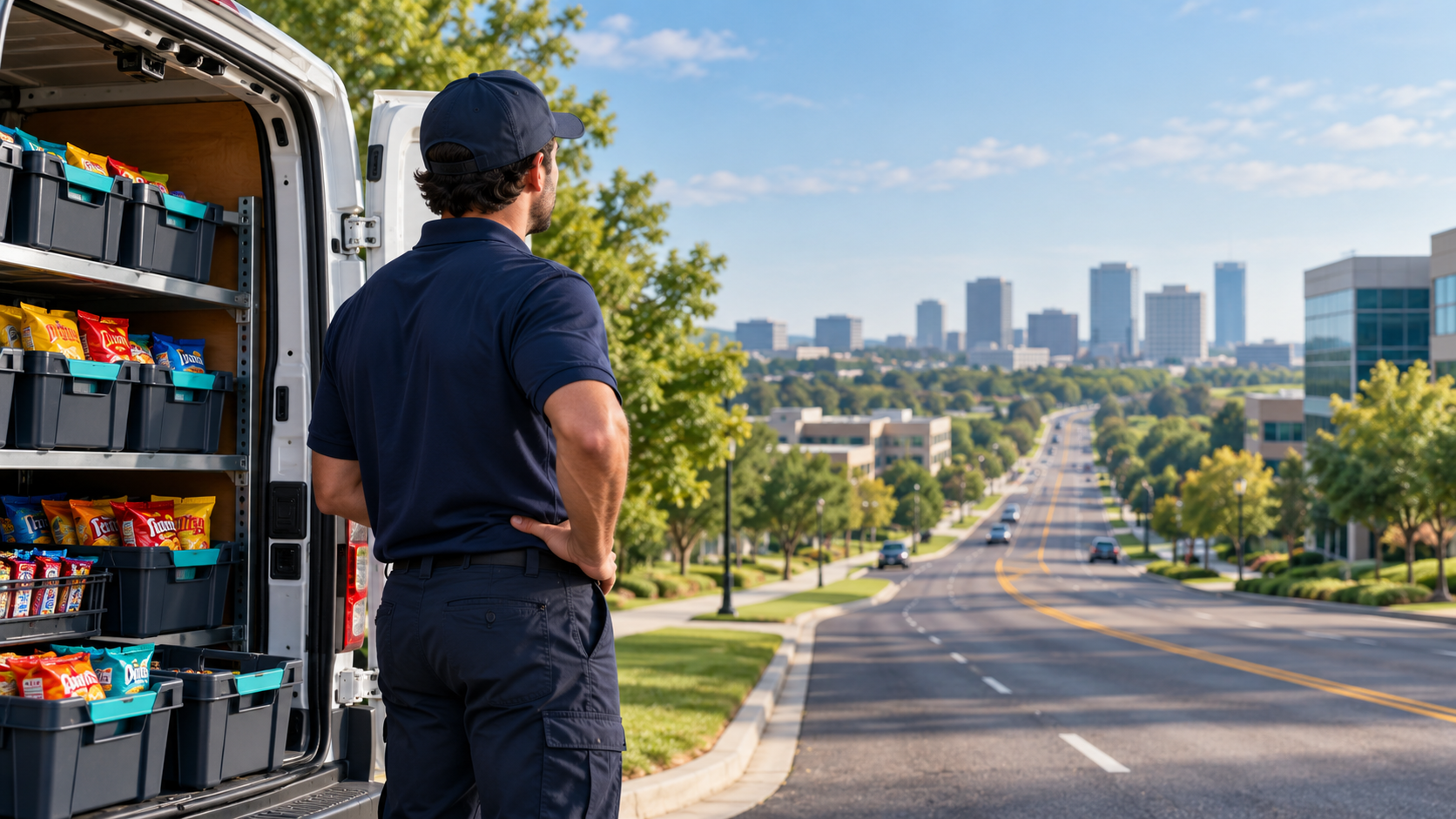
The location sounds great. The manager likes your proposal, the building has people who want snacks, and there is a clean space waiting for a machine. There is just one detail: it is forty minutes from everything else on your route.
Is that too far?
The real cost of a vending route stop depends on more than distance. It includes the extra travel the stop creates, how often you must visit, the work inside the building, and what remains from sales after the relevant costs. A nearby stop with difficult access can consume more time than a farther stop beside an existing customer.
There is no universal mileage limit that makes every location sensible. Instead, work through a repeatable calculation. The examples below are hypothetical planning exercises, not earnings claims or tax calculations. Replace every assumption with your own records before making a decision.
The goal is a route you can serve reliably and a business that rewards the time and capital you put into it.
1. Measure the travel the stop actually adds

Start by distinguishing a dedicated trip from an addition to an existing route. If you leave your normal starting point, visit one location, and return, that stop creates the whole trip. If you already pass near it while serving three other buildings, the additional travel may be much smaller.
Use the actual sequence of stops and realistic access windows. A map showing that two buildings are close does not help if one accepts service only early in the morning and the other requires an afternoon appointment.
Compare the route with the candidate stop against the route without it. The difference gives you an initial estimate of added distance and driving time. Include the return leg or the travel to the next required destination. Do not measure only the convenient outbound portion.
Keep two views of the economics. The incremental view asks what extra cost the stop adds today. A full-route view allocates shared costs across all stops so the business as a whole still covers its expenses. A stop that looks attractive on incremental cost may still need to contribute toward vehicle ownership, storage, and administration.
Neither view should be manipulated to justify a location you already want. Choose a consistent method, label it, and show the assumptions. If you allocate shared driving by service time or another reasonable basis, use that approach consistently and review it when the route changes.
Consider realistic traffic conditions, loading arrangements, parking, and repeat visits. A clear Sunday test drive can underestimate weekday service. A short distance through a congested area may take longer than a longer trip on a predictable road.
Also ask what happens when the surrounding route changes. If the nearby anchor account closes, would you still make the trip? A location that works only because of another stop deserves that note in your review.
Before pursuing a building, pair this travel check with our guide to evaluating vending foot traffic. Route convenience cannot make up for customers who rarely have an opportunity or reason to buy.
Keep a dated route log rather than relying on memory. Record the stop sequence, actual distance, arrival and departure times, and unusual delays. A few ordinary visits give you a more useful planning baseline than a single estimate made while pitching the location. Keep personal travel distinct so your operational comparison stays consistent.
Record the ordinary trip, not the most optimistic trip you can imagine. You can improve a route later, but you need a credible starting point first.
2. Count the minutes after you park

Driving is easy to notice. The small steps inside a building are easier to forget, especially when you tell yourself that stocking takes only fifteen minutes.
Start a service-time record when you begin the stop-related work. Include parking, unloading, walking, signing in, waiting for access, opening the machine, counting, stocking, cleaning, testing, handling a reported issue, and returning to the vehicle.
Record the pieces separately for a few visits. You may discover that the machine itself takes twelve minutes while the loading and access routine takes another twenty. That finding points toward a different improvement than buying faster inventory software.
Include preparation and follow-up. Shopping, receiving inventory, packing location bins, reconciling cash, recording losses, and responding to customer messages are part of operating the stop. Allocate shared work sensibly rather than pretending it belongs nowhere.
If you do the work yourself, choose an owner-time value for planning and label it clearly. An imputed value is a way to compare opportunities; it is not automatically a payroll expense or a tax deduction. If you employ someone, use the relevant actual labor costs and avoid counting the same time twice.
Consider a simple example. A stop takes 35 minutes of additional driving, 25 minutes inside the facility, and ten minutes of allocated preparation. That is seventy minutes per visit. Four visits use four hours and forty minutes. At an illustrative $24 per hour, the time allowance is $112.
The number is not a recommended wage. It shows why counting only the 25 minutes beside the machine can change your conclusion. Use a value that reflects your circumstances and compare it with what the business actually pays or needs to support.
Keep setup work separate from recurring service. Initial installation, onboarding, and product-layout work matter, but they do not necessarily repeat every week. A useful report shows both the cost of adding the location and the ongoing burden of serving it.
Finally, leave room for variability. Security delays, unavailable elevators, and customer issues may occur irregularly. A route planned to use every minute of every available hour has little capacity to absorb an ordinary problem.
When access is consistently slow, discuss it with the authorized location contact. A workable delivery window or approved loading arrangement can be more valuable than shaving a few seconds from each row.
3. Build a cost model that does not double-count

Start with sales for a consistent period. Deduct the cost of products sold, applicable payment charges, agreed commission, inventory losses, and other relevant costs. Keep sales tax collected for a taxing authority separate where applicable, and do not confuse processor deposits with sales.
Our vending profit example walks through that distinction. The amount remaining before route service is what you are evaluating against travel, labor, overhead, equipment, and other obligations.
For vehicle planning, fuel is only part of the picture. Consider maintenance, tires, insurance, depreciation or lease costs, and the portion reasonably attributable to the business. Your cash payments and economic costs may occur at different times.
You can use a clearly labeled per-mile planning estimate derived from your records, or allocate actual costs directly. Do not use an all-in estimate and then add the same fuel, maintenance, and ownership expenses again.
Tax rules are a separate question. The IRS overview of business use of a car explains that eligible taxpayers generally calculate deductible vehicle expenses using the standard mileage or actual-expense method. A tax deduction method does not establish what your particular route actually costs. Confirm the appropriate tax treatment separately.
Add parking and tolls if they are not already included in your estimate. Record unusual access charges or required handling costs. Small recurring amounts matter when the stop’s remaining contribution is modest.
Then decide how to treat equipment and shared overhead in the review. Depreciation, financing principal, interest, and a repair reserve are different things. Label them rather than compressing them into one unexplained “machine cost.” A reserve transfer does not itself create a new operating expense.
For a first comparison, you can show the remainder before those items, provided the heading says so. Avoid calling that number final net profit. A transparent partial calculation is more useful than a complete-looking calculation with missing categories.
Use actual bills when available and mark provisional estimates. Save the assumptions next to the result: visits per period, added miles, allocated hours, vehicle allowance, and costs excluded. When the route changes, you can update the relevant input rather than rebuild the entire analysis.
Check the model for duplicate deductions. If the employee’s driving time is already in labor, do not add it again as owner time. If documented expired inventory is already included in your product-cost calculation, do not subtract the same loss a second time.
4. Compare two hypothetical stops on the same basis

Imagine two locations, each generating $700 in monthly sales. After products, payment charges, commission, and inventory losses, each has $280 remaining before route service and the other costs we identify below.
Location A is near an established route. Four monthly visits add ten miles each, or forty miles for the month. Using a hypothetical $0.60 per-mile vehicle allowance produces $24 of vehicle cost. Total allocated driving, service, and preparation time is three hours. At an illustrative $24 per hour, the time allowance is $72.
Its remaining amount after those two allowances is $184: $280 minus $24 minus $72.
Location B needs a dedicated trip. Four visits add fifty miles each, or two hundred miles monthly. The same hypothetical vehicle allowance produces $120. Its total allocated work is seven hours, valued at $168 under the same assumption.
Its remaining amount is negative $8: $280 minus $120 minus $168.
| Monthly planning item | Location A | Location B |
|---|---|---|
| Sales | $700 | $700 |
| Remainder before route service | $280 | $280 |
| Vehicle allowance | $24 | $120 |
| Time allowance | $72 | $168 |
| Remainder after these allowances | $184 | −$8 |
These are teaching assumptions, not industry averages. The final row still excludes any uncounted shared overhead, equipment costs, financing effects, and income taxes. It is not take-home pay. The $0.60 estimate is not an IRS mileage rate.
The comparison explains why equal sales do not mean equal value. It also gives you useful questions. Could B be combined with another verified stop? Could access or packing improve? Is there enough demand to support the service burden? Would a different supported capacity arrangement reduce visits without causing stockouts or freshness problems?
Test the assumptions instead of changing them until the answer turns positive. If B needs five visits rather than four, vehicle cost becomes $150. If total time rises proportionally to 8.75 hours, the time allowance becomes $210. The same $280 pre-route remainder then leaves negative $80 before the other excluded items.
Conversely, fewer visits are not automatically better. Cutting a necessary visit may reduce sales, increase empty selections, or damage the service relationship. Recalculate both the cost and the likely operating effect, then verify with actual results.
Write down what would need to be true for the location to work. That creates a decision you can test rather than a feeling you have to defend.
5. Improve the route without weakening the service

The most useful improvement removes avoidable work while preserving a dependable customer experience. Start with the delays your records actually show.
Pack by location using accurate stock information. Check planned substitutions before leaving. A forgotten product or tool can turn a profitable visit into two trips, and the second trip may never appear in your original estimate.
Confirm access arrangements and known closures before a long drive. Keep current contact details and a backup contact where the location provides one. A building that is open to employees may still be unavailable to outside vendors during certain hours.
Group stops by both geography and service windows. A slightly longer route can be more practical if it avoids repeated backtracking or long waits. Review actual travel after trying the sequence; the map is a plan, not evidence of what happened.
Use stock and sales information to revise visit frequency. A machine that repeatedly has plenty of fresh inventory at every visit may support a different interval. A machine that runs out early may need more capacity, a revised assortment, or more frequent service. Our restocking guide covers those tradeoffs.
Consider equipment reliability before accepting a distant placement. Routine servicing is only one part of the commitment. A failed reader or dispensing problem may require an extra visit. Do not assume remote monitoring eliminates physical work.
Keep maintenance within the equipment instructions and your competence. If a repair needs a qualified technician, include that reality in the service plan rather than assuming every fault can be solved during a quick refill.
Adding nearby accounts can improve route density, but distinguish an established customer from a prospect. Do not justify a weak stop using three buildings you hope will eventually say yes. Show a current-case calculation and a separate expansion scenario.
Review improvements over comparable periods. If you save twenty minutes at each of four visits, that frees eighty minutes monthly. Whether it reduces cash expense depends on how labor is paid, but it still creates capacity you can use.
For help keeping the routine organized, explore Vending 102: Staying Organized & Running Your Business Like a Pro. A consistent worksheet and location packing list are useful places to start.
6. Decide how far is too far for your business

A practical distance limit comes from your capacity, costs, service commitments, and the location’s contribution. It may differ for a stop on an existing route and a standalone placement.
Before accepting a location, record expected sales with an honest basis, required visits, added mileage, total work time, and the costs your model includes. Show a weaker-demand or extra-visit case as well as the ordinary case. If the decision works only under the best assumptions, say so.
For a new placement, set a review after you have enough ordinary operating history. Our first-30-days tracking guide explains what to record before treating an opening month as a final verdict.
Is a machine twenty miles away too far? Not necessarily. The added journey, access time, visit frequency, and contribution matter more than a single distance. Twenty miles along an existing route and twenty miles in the opposite direction are different commitments.
Should I ignore my time while I am getting started? You may choose to reinvest effort, but record it. Otherwise, you cannot tell whether the business can eventually support paid help or whether the next location will exceed your capacity.
Can I use fuel cost alone? It can describe fuel spending, but it does not represent the full vehicle or service burden. Label the limited calculation and add the missing categories before making a broader profitability claim.
Should I remove a distant machine immediately? Review the evidence, possible improvements, and your agreement first. Coordinate any change with the authorized location contact. A spreadsheet supports the decision; it does not cancel commitments.
The right question is not simply “How far is the machine?” Ask, “What does this stop add to the route, what does it require from me, and what remains after I count that work?”
That answer gives you a stronger basis for saying yes, improving the service plan, or passing on a placement that does not fit.


