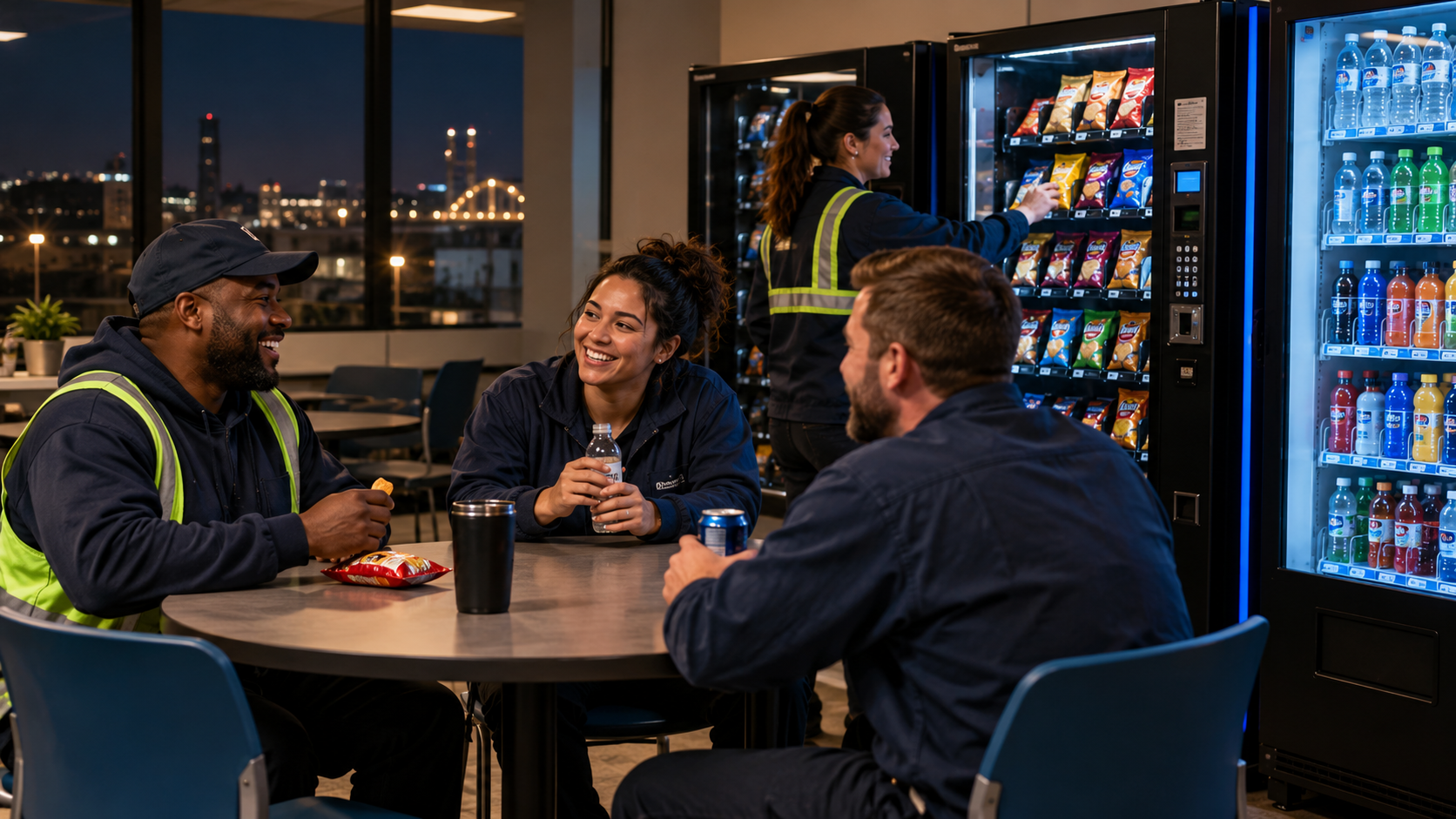
The snack machine looked great at 10 a.m. By the time the overnight crew took its break, the favorite drinks were gone and the remaining choices did not match what anyone wanted.
That is a service problem a daytime visit can miss.
Night-shift vending works best when the product mix, machine capacity, refill timing, and support process reflect the people using the breakroom after normal office hours. A workplace that operates around the clock needs a plan for all of its shifts, not just the one present when the vending operator visits.
For Cincinnati-area facility managers and operators, the starting point is the same: learn the actual work pattern. A warehouse, manufacturing site, care facility, or other extended-hours workplace may have very different needs even when their employee counts look similar.
This guide explains how to build and review that plan. Examples are illustrative, and the images show fictional workplaces rather than documented customer locations.
1. Learn who uses the breakroom after dark

Ask for the number of people normally on each shift, the times they take breaks, and the days those shifts operate. A building’s total headcount is not the same as the number of people who can reach a particular machine.
Find out whether overnight employees use the same breakroom as the daytime team. Some sites have separate buildings, controlled-access areas, or distant work zones that change the practical vending audience.
Ask whether workers can leave the site during a break and what other food options are actually available at that hour. Do not assume a nearby restaurant helps if it is closed, too far away, or inaccessible within the break period.
Include weekend patterns. A location might run full weekday night shifts but only a small maintenance crew on Sunday. Another may have its busiest period when the office staff is away.
Temporary staffing, overtime, seasonal demand, and special projects can also change the audience. Ask how the facility can notify you when those changes are planned.
Speak with the authorized facility contact about gathering input from each shift. The daytime manager may know the overall operation but may not hear every overnight complaint.
A short conversation with the shift supervisor can reveal practical details: which products disappear first, whether the room is accessible, and whether employees know how to report a problem.
Avoid treating night-shift workers as one uniform customer group. Preferences vary by workplace and by person. Use their feedback and actual purchases instead of stocking from a stereotype.
For an existing machine, compare the service record with the shift pattern. If inventory is checked only at midday, the record may describe what remains after overnight demand rather than what was available when the night shift arrived.
When transaction timestamps are available, confirm the reporting time zone and interpret the data carefully. A purchase time can suggest a demand window, but it does not identify an employee’s shift by itself.
Our guide to evaluating vending foot traffic offers a broader framework for connecting a building’s activity with the actual opportunity at the machine.
Write the important findings into the location record. “Open 24 hours” is a useful label, but it is not a substitute for the specific audience and access pattern.
2. Build a product mix from requests and real demand

Start with a balanced selection that fits the equipment and the location. Familiar snacks, bottled water, and the drinks customers request can provide a base while you learn which products earn their space.
Ask about different types of choices rather than requesting an unlimited wish list. Do employees want more savory options, smaller portions, a particular beverage, or something more substantial during a long shift?
Examples to evaluate might include crackers, pretzels, popcorn, nuts, bars, cookies, or other packaged products compatible with the machine. These are categories to consider, not a claim that every item will suit every workplace.
Review package dimensions, dispensing compatibility, supplier availability, product life, and price before adding an item. A requested snack is not ready for the machine merely because you found a case online.
Let customers use the manufacturer’s ingredient and nutrition information to make their own choices. Do not invent dietary, allergen, or health claims for products, and do not promise that a selection meets a particular need without checking the actual label and applicable requirements.
Include drink preferences beyond one narrow category. Some customers may want water or a caffeine-free choice; others may request a specific beverage. Stock according to verified demand and workplace policies.
Avoid presenting energy drinks or snacks as a solution to fatigue or a way to work safely without rest. The vending plan is about product access and customer preference, not medical advice or a substitute for workplace fatigue management.
If employees ask for refrigerated meals or other perishable foods, evaluate the equipment, transport, monitoring, rotation, and applicable food-handling requirements before offering them.
A conventional snack machine does not become suitable for perishable food because the breakroom stays cool. Match products to equipment and handling procedures designed for them.
Start new products with a controlled test. Give the item a defined selection, quantity, price, and review period. Record sales and waste alongside customer comments.
Use our vending planogram guide to organize the layout so a successful product gets appropriate space and a trial does not accidentally displace several dependable sellers.
Keep the manager informed about the test. “We are trying this selection and will review the results” is more accurate than promising a permanent addition before you know whether it works.
A thoughtful mix gives the night shift meaningful choices while keeping the inventory manageable. Variety matters, but availability and dependable dispensing matter too.
3. Schedule stock to last through the next shift

A machine can be adequately stocked for one group and poorly stocked for the next. The question is not only how much you load, but when the products are likely to sell before the next service opportunity.
Consider a fictional workplace with a large daytime crew and a smaller overnight team. The operator refills on Monday morning, and a popular drink sells heavily during the first shift. By Monday night, that selection may be empty even though many other products remain.
The machine is not necessarily too small overall. Its capacity may be allocated poorly, or the refill timing may not match the demand pattern.
Review sales by selection, loading depth, and the time between visits. Look for repeated stockouts in the same products rather than judging the whole machine by a quick visual glance.
Where supported by the equipment and the product plan, consider giving a strong seller another selection or adjusting the quantity loaded. Make changes deliberately and record the new layout.
Check whether a different service window would help. A visit before a high-demand period may serve both shifts better than a convenient stop after most of the sales have already happened.
Confirm the location’s access rules before changing the route. The building may operate all night without allowing outside vendors to enter at any hour.
Remote data can help identify demand, but it does not eliminate the need for accurate loading records and physical checks. Make sure the information you use reflects the actual machine configuration.
If you lack detailed telemetry, ask the shift contact to report the product and approximate time when an important selection is empty. A specific report is much more useful than “the machine is always out.”
Use a demand-based restocking schedule and update it as the pattern becomes clearer. Avoid promising the same refill frequency to every site without considering volume and access.
Watch slow sellers as well. Increasing the load across the entire machine can create more waste while leaving the real stockout problem unresolved.
For products with shorter selling windows, coordinate the visit interval and loading quantity carefully. Our guide to reducing expired inventory explains how overstocking can hide behind a machine that looks impressively full.
The objective is a useful selection when each shift arrives. A photograph taken immediately after refill is only one moment in that service cycle.
4. Make access, payment, and support clear at night

Before discussing new snacks, check whether employees can use the machine comfortably during their actual break. The breakroom should be accessible through the location’s approved routes, with suitable lighting and room to approach the equipment.
Work with the facility on placement and access. Do not block required paths, exits, or service clearances, and follow the applicable site and equipment requirements.
Make sure the vending area is available to the intended shifts. A machine behind a locked office door is not an overnight amenity simply because the building is open.
Payment instructions and prices should be readable. Confirm which payment methods the equipment actually supports and explain any relevant customer steps.
If a smart cooler is part of the setup, provide the correct shopping instructions and explain the possibility of a temporary authorization using the provider’s actual policy.
Our guide to smart cooler holds versus charges can help operators distinguish a pending authorization question from an incorrect completed purchase.
For a conventional card-reader problem, record the device and symptoms and use the approved troubleshooting process. See the offline card-reader guide for a structured starting point.
Keep the support contact visible at the machine. A customer who has a problem at 2 a.m. should know where to report it, what information to include, and when a response is normally available.
Be precise about service hours. A machine available for purchases around the clock does not automatically come with a technician or support representative available around the clock.
Agree on how the facility should handle an urgent equipment issue outside the normal service window. Use the site’s established process and the equipment provider’s guidance rather than leaving employees to improvise.
For ordinary purchase complaints, useful details include the location, machine identifier, date, approximate time, amount, and description of the problem. Do not request full card numbers or security codes through casual messages.
The shift supervisor should know the reporting process, but should not have to troubleshoot internal equipment or collect sensitive payment details from coworkers.
When the operator follows up, record the resolution and communicate it through the agreed channel. An overnight report should not disappear simply because it arrived when the office was closed.
5. Give every shift a practical way to provide feedback

Feedback often follows the person who is easiest to reach. If the operator only talks to daytime staff, the product plan can become a picture of one shift’s preferences.
Work with the facility to gather input from the overnight team through an appropriate channel. A brief request form, a shift-contact conversation, or a small set of questions can be enough.
Ask what is useful: which products they buy, which selections are often unavailable, which requests they would realistically purchase, and whether any part of the payment or support process is confusing.
Keep the process proportionate. You do not need employees’ personal schedules, private health information, or detailed identities to learn that a particular drink sells out before their break.
Separate a product request from a confirmed purchase pattern. Ten people may express interest in an item, but the trial still needs actual sales data before it receives permanent space.
Tell employees how requests are evaluated. Availability, equipment fit, supplier consistency, pricing, and inventory turnover all influence the decision.
When you decline a request, give a concise, useful reason if appropriate. Perhaps the package does not dispense reliably in the existing machine, or a refrigerated product requires a different setup.
When you approve a trial, communicate what changed and when it will be reviewed. That makes the feedback process visible without promising that every suggestion will stay.
Use a small tracking table in your own records:
| Feedback | Useful follow-up |
|---|---|
| Favorite drink empty at night | Check the selection’s capacity, sales pattern, and refill timing |
| Request for a new snack | Review compatibility, supply, price, and a limited trial |
| Payment concern | Use the provider’s transaction-support process |
| Breakroom inaccessible | Confirm site access with the authorized facility contact |
Do not let one strongly worded complaint stand in for the entire shift. Investigate it respectfully, then compare it with other observations and the service record.
Likewise, do not ignore a specific problem because total sales look healthy. A machine can produce revenue while consistently failing a smaller group of customers.
If the location contact changes, preserve this feedback process in the handover. A useful vending program should not lose the overnight team’s input whenever management responsibilities move.
6. Review the setup with the location before expanding it

After a defined period, review the changes with the authorized location contact. Compare availability, product sales, waste, complaints, and the effort required to service the machine.
Look at comparable operating periods. A week with unusual overtime or a holiday closure should not automatically become the standard forecast for every future week.
Ask whether the night shift can find useful products when needed. Review the specific selections that were adjusted and whether the change improved availability across the full service interval.
Set the next review date before ending the conversation. Record which changes will remain, which trials will end, and what still needs more evidence. Give the shift contact a simple way to report a renewed stockout so an improvement does not quietly fade after the initial review.
Check the route economics too. More frequent visits may help availability, but they need to fit a sustainable service plan. Our guide to the real cost of a vending route stop explains why travel and service time belong in the decision.
If the equipment is consistently unable to meet verified demand, discuss suitable alternatives. That might involve reallocating selections, changing the product mix, adding capacity, or considering a different equipment format.
Evaluate each option against the location’s needs and constraints. Do not recommend another machine solely because the site operates 24 hours.
For Cincinnati-area facilities exploring service, Big City Vending’s service overview describes stocking, maintenance, and payment options, with free placement available for qualifying businesses. The appropriate setup depends on a location review.
Use the contact and support page to discuss your facility, location, and approximate number of people on site. Include the shift pattern so the conversation reflects the whole workplace.
Operators organizing these records can also explore Vending 102: Staying Organized & Running Your Business Like a Pro.
Does a 24-hour site need overnight restocking? Not necessarily. The service plan should match demand, capacity, and approved access.
Should night shifts get different products? Use their requests and purchase patterns to decide. Avoid assumptions based only on work hours.
Does 24-hour vending mean 24-hour support? Confirm the actual support and response arrangements separately.
The night shift should not inherit only what the daytime crew leaves behind. With the right quantities, timing, feedback, and service process, the vending setup can serve the people who keep working after the office lights go out.


