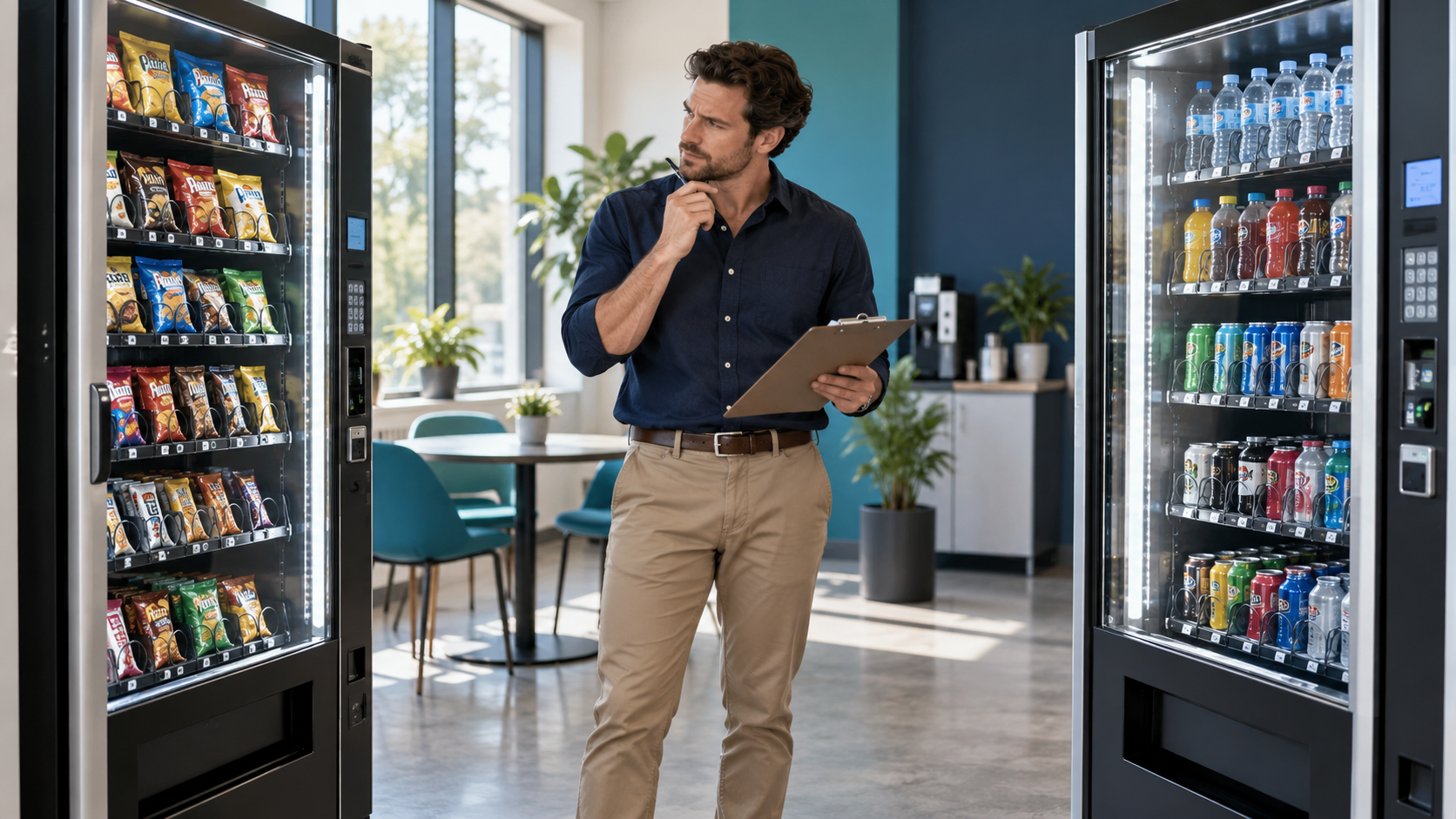
The used machine looks like a bargain. You can picture it in a busy breakroom, and adding another stop feels like the next logical step.
Meanwhile, one machine on your current route runs out of its best drink, another has slow snacks aging in the back, and last month’s records are still waiting to be organized.
Before you buy another vending machine, compare the expected benefit of expansion with the improvements available in the equipment and locations you already have. Growth can make sense. So can a better product layout, a repaired reader, a tighter route, or a more dependable service routine.
The right choice depends on the constraint in your business. More equipment helps when equipment capacity or a verified new opportunity is the limiting factor. It helps less when the problem is weak records, inconsistent service, or an unproven location.
This guide offers a practical comparison. All financial examples are fictional planning illustrations, not equipment price quotes, industry averages, or promised returns. Images show fictional operating scenes.
1. Establish what your current machines actually produce

Start with a baseline for each location. Record sales, product costs, payment costs, commissions where applicable, waste, service time, travel, repairs, and the other costs relevant to your decision.
Use a period long enough to understand the normal operation, and note unusual events. A holiday shutdown, temporary overtime, or a new employee group can change a month’s results without changing the long-term opportunity.
Separate cash flow from profit. Inventory purchased today may be sold later, a machine purchase is different from routine product expense, and loan payments require appropriate treatment in your financial records.
Our walkthrough of what you keep from vending sales explains why the headline sales total cannot answer the whole question.
Make sure the sales figures are credible. Reconcile payment reports and cash collections, and investigate unexplained differences. The guide to vending sales versus bank deposits can help you organize that review.
Then ask what the current equipment fails to do. Does a machine run out of strong sellers before the next visit? Does it have payment problems? Is it in an area that customers cannot easily reach?
Look for specific evidence. “This location could do better” is an impression. “The same drink selection was empty before three consecutive visits” is a problem you can investigate.
Include the location relationship. A manager who is satisfied, reachable, and willing to discuss improvements creates a different operating situation from a placement with unresolved access or service disputes.
Check your own workload. If you already miss visits or struggle to respond to routine issues, a new machine may add obligations before it adds useful capacity.
Write a short baseline for the route as a whole: what it earns under your chosen definitions, how much time it takes, which problems repeat, and how much usable capacity remains in the service schedule.
Do not wait for perfect data before doing anything useful. Identify missing information and collect it during the next normal service cycle. A short measurement period may be more valuable than an immediate purchase.
For a location that is still new, use the first-30-days tracking guide before treating early results as a stable forecast.
2. Identify improvements with a clear cause and measurable result

List the improvements available in the current route, then connect each one to a problem. The strongest candidate is usually something you can explain and measure.
A product-layout change might address repeated stockouts in a popular item while reducing space given to a slow seller. Use the planogram guide to document the before-and-after arrangement.
A refill timing change might improve availability during a busy shift without adding another machine. Review how to set a demand-based restocking schedule and check the location’s approved access windows.
A product rotation improvement might reduce avoidable waste. The benefit comes from the actual reduction in losses, not from assuming every unsold snack would otherwise have become a sale.
A repair may restore dependable service. Get an appropriate diagnosis and estimate instead of buying replacement equipment before understanding the fault.
Our repair-or-replacement guide can help organize that comparison. Use the model’s instructions and qualified service support for work outside your capabilities.
Better route preparation may save travel or repeat visits. Record the time and distance before and after so you can see whether the change produces a real benefit.
Do not count every operational improvement as extra revenue. Some reduce cost, some reduce time, some improve reliability, and some protect a valuable relationship. Describe the benefit in the right terms.
Prioritize a small number of changes. If you alter prices, products, layout, service frequency, and payment settings at once, it becomes difficult to know which change affected the result.
For each trial, write the problem, action, cost, start date, review date, and measure of success. Keep the trial proportionate to the location and avoid promising the manager a permanent change before you have evidence.
Include a stopping rule. If a new product does not sell or a service change creates more work than it saves, revise the plan rather than continuing merely because you announced it.
Improvement is not automatically the cheaper or better option. An aging machine may have limited parts support or insufficient capacity. The point is to compare a realistic improvement with a realistic purchase.
3. Check whether your operation can support another machine

Another machine requires more than an empty space on a route map. It may need additional inventory, storage, loading time, vehicle capacity, service visits, records, and customer support.
Estimate the full service cycle. Include ordering, receiving, checking product condition, packing, travel, access, restocking, cleaning, cash handling where relevant, and the administrative work afterward.
A machine that takes twenty minutes to fill can require much more than twenty minutes of business time. A realistic estimate follows the work from preparation through completed records.
Check whether the new location fits an existing route or creates a separate trip. Our article on the real cost of a vending route stop explains why distance and access matter.
Consider the vehicle and storage area you actually use. More drink cases can create a loading or handling constraint before the machines themselves reach their potential.
Review whether products can be stored and transported appropriately. Do not add perishable inventory without the equipment, handling process, monitoring, and applicable requirements needed to support it.
Identify backup coverage. Who can respond if you are unavailable, a vehicle needs repair, or two locations require service at the same time?
Do not assume a family member or friend has agreed to cover the route. Confirm responsibilities, access, training, and the practical limits of any backup arrangement.
Check your administrative capacity too. More devices can mean more payment reports, device subscriptions, maintenance records, and location contacts.
If the business depends on you remembering everything, expansion is a good reason to document the routine before the next placement begins.
Ask whether the planned purchase solves a capacity problem or creates one. A larger machine at a proven high-demand site may reduce service pressure, while another distant stop may increase it.
Keep these situations separate: replacing unreliable equipment, adding capacity at an existing location, and entering a new location are different decisions with different evidence.
Finally, leave room for ordinary disruptions. A route planned at its absolute limit can become difficult to maintain when a delivery runs late or a machine needs attention.
4. Calculate the complete cash requirement and compare examples

The advertised machine price is only one part of the purchase. Obtain realistic estimates for transport, installation, necessary repairs, payment equipment, setup charges, initial stock, and any other applicable costs.
Also plan for cash needed while the location develops. Product purchases and other obligations can arrive before the new machine produces dependable receipts.
Separate the initial cash requirement from recurring expenses and from accounting profit. If financing is involved, review the actual terms, total obligation, payment schedule, and what happens if the location underperforms.
Do not compare a financed machine’s monthly payment with an improvement’s full upfront cost as though they measure the same thing. Put the options on a consistent basis.
Here is a deliberately simplified example. Suppose an improvement costs $600 and is expected to add $75 a month in net incremental cash benefit after the extra recurring costs included in the model.
Its simple payback is $600 divided by $75, or eight months. If the benefit is only $30, the same calculation becomes twenty months.
Now suppose an expansion requires $5,000 in initial cash and is expected to add $250 a month on the same defined basis. Simple payback is twenty months. At $100 a month, it becomes fifty months.
| Illustrative option | Initial cash | Monthly net incremental benefit | Simple payback |
|---|---|---|---|
| Improve existing equipment, expected case | $600 | $75 | 8 months |
| Improve existing equipment, lower case | $600 | $30 | 20 months |
| Expand, expected case | $5,000 | $250 | 20 months |
| Expand, lower case | $5,000 | $100 | 50 months |
These figures do not establish which option is best. Simple payback ignores the timing of cash within the period, taxes, residual value, benefits after payback, and other factors. It also fails if the assumed monthly benefit does not occur.
For this example, owner time, financing, and broader business costs require a separate review; do not present the table as complete profit or a guaranteed return.
Record the source of every assumption. A repair quote is different from a guess, and an existing location’s documented sales pattern is different from a seller’s unsupported projection.
Break-even analysis offers another planning view. The SBA’s break-even guide relates costs and contribution margin to the sales needed to cover the modeled costs. Use appropriate assumptions for the actual product mix.
Test lower sales, higher product costs, an extra service visit, and an unexpected repair. An option that needs everything to go perfectly deserves closer scrutiny before you commit.
5. Verify the location opportunity and the equipment fit

A cheap machine without a workable placement can tie up cash and storage space. Before buying for a new location, verify the demand, decision-maker, access, and service expectations.
Use the foot-traffic evaluation guide to distinguish a busy building from a practical vending audience. The relevant question is who can use the machine, when, and with what alternatives.
Confirm that the person approving the placement has authority and that the arrangement is documented appropriately. A friendly conversation is not the same as an approved installation.
Check the exact equipment needs. Snack capacity, beverage capacity, product dimensions, payment compatibility, and refrigeration requirements all affect whether a machine fits the opportunity.
Follow the installation checklist for the delivery route, utilities, clearances, access, and responsibilities. A machine that cannot reach the intended spot is not a useful bargain.
For used equipment, verify its identity, condition, ownership, included parts, service history, and the ability to obtain support. Have an appropriate inspection and demonstration before relying on a seller’s description.
Check the payment device separately. Physical possession of a card reader does not necessarily establish that it can be activated or transferred to your account on the terms you expect.
Confirm transfer and compatibility through the provider’s official process. Do not accept the seller’s account credentials as a substitute for authorized ownership and account setup.
If you are adding a machine beside an existing one, consider how much demand will be new and how much will shift from the old machine. Counting all sales on the new machine as additional route revenue can overstate the benefit.
Ask what unmet need the additional equipment serves. More capacity for products that repeatedly sell out is a clearer reason than simply making the breakroom look more impressive.
For a weak location, review whether the placement is worth keeping before investing further. New equipment cannot guarantee that an unsuitable audience becomes a strong market.
Document the decision with the location contact. Make sure the installation, stocking, and support plan matches what you can actually provide.
6. Choose the next step and set a review date

You do not have to choose between permanent expansion and doing nothing. A short improvement trial, a better location review, or a completed equipment inspection can be the next useful step.
Choose improvement first when a specific, affordable change addresses a documented constraint and you can measure the result. Give the trial a clear end date.
Consider expansion when the placement is verified, the equipment fits, the full cash requirement is manageable, and the route has capacity to provide dependable service.
Consider waiting when the main assumptions are still unsupported. Waiting with an information-gathering plan is different from postponing the decision indefinitely.
Make the review fair to both options. An improvement at a mature location has operating history behind it, while a new placement may need time to develop. Compare the uncertainty as well as the expected return. A slightly smaller benefit supported by reliable records may fit your circumstances better than a larger forecast built from assumptions.
Include the effect on existing customers. If the new stop makes current visits late or leaves popular products unavailable elsewhere, part of the apparent gain may be offset by weaker service across the route. Track the route total alongside the new machine so that this tradeoff remains visible.
Ask what evidence would change your mind before spending. A confirmed placement, a revised repair estimate, a successful product trial, or a better service arrangement might alter the comparison. Writing that condition down helps keep the decision grounded when a limited-time offer creates pressure to act quickly.
Write a one-page decision record. Include the options considered, expected benefits, costs, time requirements, key risks, missing information, and the reason for the chosen action.
Separate sunk costs from future decisions. Money already spent may explain how you arrived here, but the next choice should compare the costs and benefits still ahead.
Preserve cash for the operating needs you have identified. A purchase that leaves no room for stocking or ordinary service can make an otherwise promising placement difficult to manage.
After implementation, compare actual results with the assumptions. If the improvement saves less time or the new location sells less than expected, update the plan early.
Do not move the success target after every disappointing month. Review the evidence, recognize unusual conditions, and make a deliberate decision about what changes next.
For organizing the records that support a sustainable route, explore Vending 102: Staying Organized & Running Your Business Like a Pro.
Is more equipment always growth? More equipment increases capacity and obligations. Whether it improves the business depends on the results.
Should every existing machine be perfect first? No. Compare the most valuable realistic opportunities, including a strong new placement.
What should I do this week? Measure one recurring problem, price one practical improvement, and verify the assumptions behind any proposed purchase.
The next machine should earn its place in the plan. Sometimes the best investment is another unit. Sometimes it is making the current route work as well as you thought it already did.


