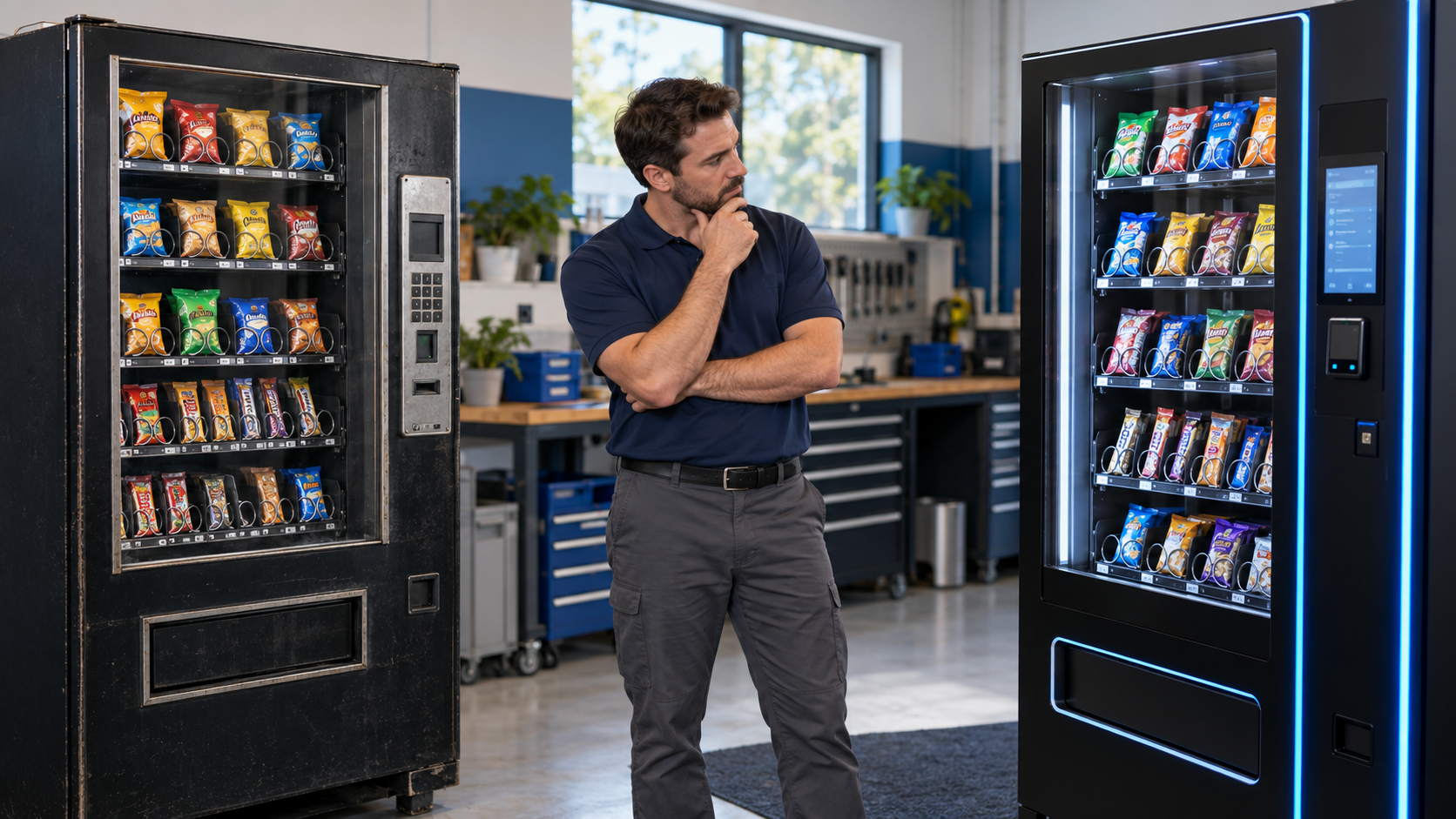
Your older vending machine has developed a talent for calling you back to the same location. First a payment complaint. Then a dispensing problem. Now there is another estimate on the desk.
You can already hear both arguments: “Just fix it; a new machine is expensive” and “Stop throwing money at that thing.” Neither argument tells you what to do with this particular machine.
A vending repair or replacement decision should compare the diagnosed problem, the machine’s broader condition, expected downtime, future operating costs, and the full cost of a suitable replacement. Age matters, but age alone is not a decision rule.
This guide helps operators organize that comparison. The example numbers are invented for illustration, not market prices, quotes, or promised returns. Use your actual service estimate, equipment condition, location performance, and cash constraints.
Before you decide what to buy, find out what you are trying to fix.
1. Get a diagnosis before turning the problem into a purchase

Write down the exact symptom and when it occurs. “The machine is unreliable” may describe your frustration, but a technician needs more detail: which selection, which payment method, what message, and what happened before the failure.
Separate payment, dispensing, refrigeration, product-fit, and site-related issues. A reader problem does not automatically mean the entire vending machine needs replacement. A snack that repeatedly catches in an unsuitable spiral may require a product or setup change.
Record the manufacturer, model, serial number, and installed payment equipment. Use the correct manual and supported troubleshooting process. For example, Seaga’s operation-manual library organizes documentation by equipment model; a similar-looking machine is not a substitute for the right instructions.
Ask a qualified technician to distinguish the immediate fault from other significant condition concerns. You want to know whether the proposed work addresses an isolated failure or one part of a machine with several unresolved problems.
Get the estimate in writing. Clarify the diagnosed cause, proposed parts and labor, what is included, what remains uncertain, the expected timetable, and any warranty on the work. An estimate based on limited information may change after inspection, so ask how additional work will be approved.
Check whether the equipment or component has applicable warranty coverage before authorizing unrelated work. Follow the warranty provider’s process rather than assuming every repair or replacement part qualifies.
Do not keep operating equipment with an unresolved safety issue merely to preserve sales. Electrical, refrigeration, structural, or food-safety concerns need the appropriate qualified assessment and handling. This business comparison is not a repair procedure.
If the issue concerns cashless payments, start with our offline card reader troubleshooting guide. Documenting the error and scope can prevent an unnecessary whole-machine purchase.
Also check the installation context. A new machine in the same unsuitable environment may inherit the same problem. Confirm that power, ventilation, placement, and operating conditions meet the relevant equipment requirements.
At the end of this step, you should be able to describe the decision in one sentence: “We are comparing a quoted repair of this diagnosed fault with a specific replacement option.” If you cannot, collect the missing information before comparing prices.
2. Read the maintenance history as a pattern

Pull the service records for a consistent period. List the date, symptom, cause if confirmed, action taken, cost, downtime, and whether the same issue returned.
Distinguish routine care from breakdowns. Cleaning and planned maintenance are part of operating equipment; emergency trips for repeated failures tell a different story. Combining everything into one undifferentiated “repair” number hides that distinction.
Look for repeated unresolved symptoms. Three visits for the same fault may suggest that the cause was not fully addressed. Three unrelated minor issues over a long period may support a different conclusion.
Include your own service time even when no outside invoice exists. A machine that consumes several extra visits can be costly without producing a dramatic parts bill. Use a consistent time value for comparisons and label it as an estimate.
Review whether missed maintenance, incorrect loading, or an unsuitable product contributed to the trouble. Replacing hardware will not automatically correct an operating practice. Our planogram guide explains how product placement and capacity decisions connect to dependable service.
Ask about parts availability and support for the actual model. A repair may be technically possible but difficult to schedule if the needed component is unavailable. Confirm current availability rather than relying on an old catalog listing.
Keep cosmetic condition separate from function while still considering the location’s expectations. A worn appearance may matter to the customer experience, but a cabinet refresh and a whole-machine replacement are different projects with different costs.
Do not let past spending force the next decision. Money already spent is useful evidence about the machine’s history, but it cannot be recovered by approving another repair. Compare the costs and benefits still ahead of you.
Likewise, do not dismiss an older machine simply because its purchase price has long been recovered. If it remains suitable, supportable, and dependable after a reasonable repair, keeping it may be a workable option.
Write a short condition summary: immediate fault, recurring issues, significant upcoming work, support availability, and any limitations the repair will leave unchanged. That summary should sit beside the estimate when you make the decision.
3. Compare the complete cost of each option

The repair price and the replacement machine’s sticker price are only the first two lines of the comparison.
For repair, include the quoted work, applicable travel or diagnostic charges, freight for parts if relevant, and any other confirmed costs. Separate work needed now from optional improvements so the estimate remains understandable.
For replacement, include the machine, delivery, professional removal or relocation of existing equipment, installation, payment-device setup, and any required site preparation. Confirm which items are already included in the supplier’s quote.
If you expect proceeds from selling the old machine, use a cautious, supportable estimate and record selling or removal costs. An asking price from an online listing is not the same as money you will actually receive.
Consider financing separately from the equipment comparison. The timing of cash payments affects affordability, while financing charges affect total cost. Do not count both the full financed purchase price and all principal payments as separate equipment costs in the same calculation.
Compare ongoing expenses over the same period. These can include expected maintenance, provider fees associated with different payment equipment, and energy costs if you are responsible for them. Avoid assuming every newer machine costs less to operate.
ENERGY STAR’s vending-machine guidance covers certified refrigerated beverage machines and describes efficiency features. Use the actual candidate model’s information and your relevant energy rate to assess its likely effect. A program average is not a guaranteed saving for your location, and it should not be applied indiscriminately to other equipment types.
Estimate downtime in terms of contribution you expect to lose, not just gross sales. If a sale does not occur, some product and transaction costs may also be avoided. Keep that distinction visible.
For a simplified illustration, suppose normal daily sales are $40 and the contribution after the variable costs included in your model is 45%. The estimated daily contribution is $18. Four affected days would represent $72 under those assumptions, not $160 of lost profit. The real effect may differ if customers buy from another machine or return later.
Our vending profit guide helps separate sales from the costs behind them. Apply the same cost definitions to both equipment options.
Include uncertainty explicitly. A technician may be confident about the current repair but unable to promise the condition of every other component. A replacement may have a delivery estimate rather than a guaranteed arrival. Record those limits instead of turning assumptions into precise-looking facts.
4. Check whether the machine still fits the location

A repair can restore a machine to its previous condition without making that condition appropriate for the location.
Review demand and capacity. If best sellers routinely run out before a practical service visit, ask whether a different layout, adjusted refill schedule, or different equipment capacity would address the problem.
Compare the actual product sizes and categories you need to sell with what the machine supports. Do not assume a replacement accepts every package shown in a promotional photo. Confirm compatibility and test the intended products through the appropriate process.
Review payment options and the complete cost of supporting them. A reader upgrade may solve a specific need without replacing the cabinet, but compatibility, activation, supported hardware, and provider requirements still need confirmation.
Consider the customer approach, control placement, pickup area, and the facility’s requirements. Have the appropriate people review suitability. Do not treat a marketing label or a larger screen as proof that the installation meets every applicable requirement.
Measure the proposed replacement and its delivery route. A machine can fit the final wall space but fail to make a hallway turn. Check the actual dimensions, weight, utilities, ventilation, and service clearances with the facility and mover.
Use the installation checklist again even if you are replacing equipment in an existing location. The new model may have different requirements from the machine leaving.
Ask whether the location itself remains worthwhile. A struggling stop may need better products, better availability, different placement, or a broader business review. A new machine is not evidence of new demand.
Separate the sales improvement you can reasonably support from the improvement you hope for. If the business case depends on a large increase in purchases, identify why customers would buy more and how you will measure it.
For example, adding a supported payment option at a location where customers regularly request it may support a testable hypothesis. Assuming that a brighter cabinet doubles sales is not a dependable planning method.
Include the facility contact in the practical discussion. They may know about a future move, attendance change, renovation, or access restriction that materially affects the value of installing different equipment now.
5. Work through a simple repair-versus-replace example

Consider an illustrative operator with a diagnosed fault in an otherwise suitable machine. These amounts are invented to show the method. They are not typical prices or a recommendation for any specific equipment.
The written repair estimate is $450. The operator adds $50 of relevant travel and handling cost, $72 of estimated downtime contribution loss, and $250 as an uncertain allowance for other maintenance during the next year. That produces a comparison total of $822.
A specific replacement option costs $3,200, with $500 for confirmed delivery and installation work. The operator estimates $36 of downtime contribution loss and $100 of maintenance allowance, then subtracts $300 of expected net proceeds from the old machine. That comparison total is $3,536.
| Illustrative 12-month comparison | Repair | Replace |
|---|---|---|
| Immediate work or equipment | $450 | $3,200 |
| Travel, handling, delivery, installation | $50 | $500 |
| Estimated lost contribution during downtime | $72 | $36 |
| Uncertain maintenance allowance | $250 | $100 |
| Expected net old-machine proceeds | $0 | −$300 |
| Comparison total | $822 | $3,536 |
Under these limited assumptions, replacement requires $2,714 more over the comparison period. That does not automatically make repair correct. It tells the operator what additional benefits or risk reduction would need to justify the difference.
This is a simplified cash-and-operating comparison, not a full accounting profit calculation. It omits taxes, financing, differences in end-of-period equipment value, and any operating costs assumed equal. Add relevant differences for your decision, and keep the method consistent.
If the replacement is expected to improve annual contribution, estimate that improvement separately and explain the evidence. Do not subtract the entire replacement machine’s projected sales; the existing machine also generates sales when operating.
Now test a less favorable repair scenario. What if another major component needs work soon? What if the part takes longer to arrive? What if the projected resale proceeds do not materialize? Changing one assumption at a time reveals what drives the choice.
Also test a less favorable replacement scenario. Delivery may cost more than expected, a proposed feature may not increase demand, or a used replacement may need work of its own. Replacement is an alternative with risks, not a guarantee of trouble-free operation.
Finally, consider the service relationship. Frequent outages at an important location may have consequences that are difficult to express as a precise dollar value. Describe that concern openly instead of hiding an arbitrary amount in the calculation.
Set a decision deadline that reflects the service problem without rushing past essential information. If both quotes are incomplete, request the missing items and identify a temporary service plan with the location. If one option is available much sooner, quantify the likely downtime difference using the same contribution assumptions. Keep affordability visible too: a theoretically attractive replacement can still create a cash shortage for inventory and routine obligations. The chosen plan needs to work for the business as well as for the machine.
6. Make the decision, document the reason, and verify the result

Repair is worth considering when the fault is understood, the quoted work is proportionate, the broader machine condition is acceptable, and the equipment continues to fit the location. Confirm parts and service support before relying on a quick return to operation.
Replacement deserves serious consideration when major unresolved problems, poor support availability, unsuitable capacity, or repeated disruption make continued operation unattractive. Compare a specific candidate and full installation plan rather than an imaginary perfect machine.
A third option may be available: an appropriate component upgrade, a professionally refurbished machine, or a different placement decision. Evaluate it with the same discipline instead of forcing every situation into two choices.
Write down the selected option, approved cost, main assumptions, responsible people, and expected timetable. Keep the diagnosis and quote with the equipment record. Future you will appreciate knowing why the decision made sense at the time.
After a repair, verify the reported fault is resolved using the proper operating checks. After replacement, confirm the installation, product dispensing, prices, payment setup, and service information. A machine that turns on has not necessarily passed a complete customer-use check.
Review the results after normal operation resumes. Track repeated failures, additional trips, customer reports, and the assumptions that justified the expense. Correct the operating plan if the evidence changes.
Is there a universal replacement age? No single birthday establishes the condition, supportability, or location fit of every machine. Use the actual equipment evidence.
Should I replace it when a repair reaches a fixed percentage of its value? A percentage can prompt a closer review, but it leaves out downtime, future work, suitability, and replacement costs. Use the complete comparison.
Does a warranty remove all risk? Read the actual coverage, exclusions, claim process, and responsibility for labor or transport. Do not assume every cost or interruption is covered.
What records help most? Diagnosis, service history, quotes, downtime, location performance, and the final test results. Keep those together.
For organizing those records, explore Vending 102: Staying Organized & Running Your Business Like a Pro. The goal is a decision you can explain with evidence—and equipment that serves the location dependably afterward.


