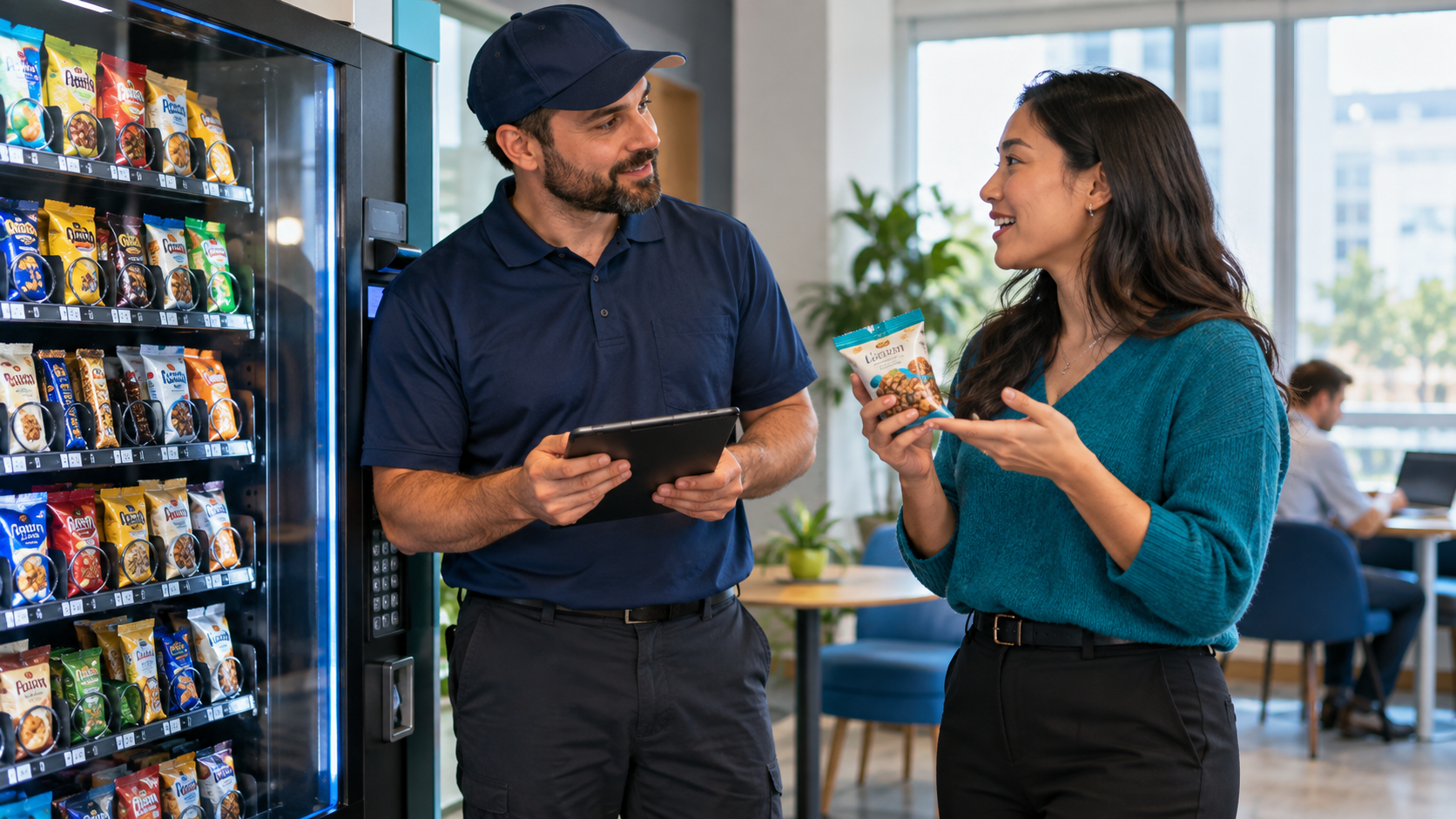
“Can you put this snack in the machine?”
It is a good question to hear. Someone uses the machine, pays attention to the selection, and is telling you how it could serve them better.
It is not automatically a purchase order for three cases.
Evaluate a new vending snack request by checking the actual product, machine fit, supplier availability, selling economics, and results of a limited trial. Customer interest starts the process. Reliable sales and workable operations determine whether the item earns a lasting place.
This guide explains how to respond without dismissing customers or filling your storage area with products that barely move. Examples are fictional, and the images illustrate concepts rather than actual customer locations.
1. Turn a vague request into a useful product brief

Start by finding out what the customer means. A brand name may cover several flavors, package sizes, or product formats, and those differences matter in a vending machine.
Ask for the exact item and size, or a photo of the manufacturer’s package. You need enough information to identify the product, not a detailed personal profile of the person requesting it.
Clarify whether they want that specific product or a broader type of choice. Someone asking for a particular cracker may mainly want a savory option that is different from the chips already available.
If an equivalent would meet the need, you may have more practical supplier and equipment options. Do not substitute silently when the distinction matters to the customer.
Ask how often they expect to buy it and whether others have requested something similar. Treat those answers as expressions of interest, not guaranteed sales.
A person can sincerely like a snack and still buy it only occasionally. Interest in a breakroom conversation is different from repeated purchases at the price you need to charge.
Record the location, requested item, date, approximate interest, and any relevant facility policy. A small request log is enough; the goal is to avoid relying on memory.
Look for patterns across shifts and visits. A request repeated by several customers over time deserves a different level of attention from one passing comment.
Do not let the most available person speak for the entire building. If you only visit during the day, the overnight team may have different requests.
Our guide to serving night-shift workplaces explains why feedback should reflect the people who actually use the breakroom across the service cycle.
Give a clear initial response: “Thanks for the suggestion. I’ll check whether we can source it, whether it works in this machine, and what a small trial would look like.”
That response acknowledges the request without promising an item before you know whether you can supply it responsibly and consistently.
If the request concerns an allergy or dietary need, let the customer rely on current manufacturer information. You do not need to collect private medical details to investigate a product.
2. Check the package, label, storage, and machine fit

Before ordering a case, inspect the actual package. Size, shape, weight, stiffness, and the way a bag sits in the selection can affect dispensing.
A snack that looks similar to an existing item may still behave differently. Packaging changes can matter even when the brand and flavor stay the same.
Use the equipment manufacturer’s guidance and an appropriate test procedure. Confirm that the product fits the intended selection and dispenses reliably under the conditions you will use.
Do not force a product into a spiral or modify equipment casually to make the request work. A customer who wanted a new snack will not appreciate paying for one that gets stuck.
Keep the package intact and the required information available. Do not remove labels or repackage items merely to squeeze them into the machine.
For dietary or allergen questions, check the current manufacturer label and supporting information. The FDA advises checking food labels each time because ingredients can change. Avoid making an unsupported “safe for everyone” or allergen-free promise.
A label claim on one flavor or package size should not automatically be applied to another. If information is unclear, consult the manufacturer rather than improvising an answer.
Check storage and transport needs. A product requiring refrigeration is not suitable for an ordinary snack machine simply because the room feels cool.
Before adding perishable products, confirm the equipment, monitoring, handling procedures, and applicable requirements. A new request can create a different operating responsibility from stocking shelf-stable packaged snacks.
Review the product’s remaining selling window when it arrives from the supplier. A low case price is less attractive if the quantity is unlikely to sell in the usable period.
Date labels have different meanings. USDA’s product-dating guidance explains common terms. Follow applicable requirements, manufacturer instructions, and your documented rotation and removal policy; do not use a general explanation of date labels to justify questionable stock.
Our guide to reducing expired vending inventory helps connect purchasing quantity, loading depth, and service frequency.
Only move to a sales trial after the basic suitability checks pass. Demand cannot compensate for an item that cannot be handled or dispensed appropriately.
3. Calculate the economics of a small trial

Find the supplier’s case quantity, delivered cost, minimum order, availability, and lead time. Check whether you can reorder the same product consistently if the trial succeeds.
Include relevant shipping and handling costs. A low unit price can change considerably when you must place a separate order for one specialty item.
Divide the relevant delivered case cost by the number of usable units to estimate the product cost per unit. Keep damaged, unsellable, or otherwise unusable items visible in your records.
Then compare the proposed selling price with product cost and the other costs affected by the sale. Payment charges and location commission, where applicable, can change the amount left to support the business.
Use actual agreement terms. Do not apply a universal payment-fee percentage or commission rate from someone else’s route.
Here is a fictional product-only example. A case of 24 snacks costs $24 delivered, and each snack sells for $2. If all 24 sell, revenue is $48 and the difference after that case cost is $24.
That $24 is not final profit. Payment costs, commissions, service costs, taxes where applicable, and other business expenses have not been included.
If only 18 sell and six become unsellable, revenue is $36 against the same $24 case cost. The product-only difference falls to $12.
| Illustrative outcome | Revenue | Case cost | Difference before other costs |
|---|---|---|---|
| 24 sold at $2 | $48 | $24 | $24 |
| 18 sold at $2; 6 unsellable | $36 | $24 | $12 |
The example shows why sell-through matters. It does not establish a recommended price, margin, or acceptable waste level.
If the remaining six are still usable inventory, do not automatically treat them as waste. Track where they are and whether they are likely to sell within the appropriate window.
Consider what the trial displaces. Removing a dependable seller has an opportunity cost, even if the new snack produces some sales of its own.
Also consider whether a new item creates extra work: separate ordering, special handling, more frequent visits, or a new supplier to manage.
For the broader picture, read what vending sales leave after costs. A snack trial belongs inside the business model, not outside it.
4. Give the product a defined place, quantity, and review period

Choose a limited trial that you can measure. Record the product, package size, selection number, price, quantity loaded, date, and planned review point.
A trial should be small enough to limit exposure while giving customers a reasonable opportunity to buy. The right quantity and duration depend on the location, service interval, and product life.
Do not use the same trial length everywhere. A busy warehouse and a lightly used office machine can produce very different amounts of evidence in two weeks.
Choose the selection deliberately. Avoid placing the new snack where customers cannot see it or replacing several strong sellers at once.
Use the planogram guide to record the change. If the product performs well, you will know which arrangement produced the result.
Confirm that the displayed price matches the configured price and that the product is assigned to the correct selection. Follow the equipment’s approved test procedure.
Tell the location contact that this is a trial. Explain when you will review sales and availability, and avoid promising permanent stock before the evidence exists.
A short message could say: “We added the requested snack for a limited trial. We’ll review sales and stock condition after the agreed period and let you know whether it will stay.”
Where appropriate and approved by the location, make customers aware that the item is available. Do not assume the person who requested it will discover it immediately.
Keep the rest of the test reasonably stable. If you change the price, placement, and package size repeatedly, note each change rather than combining all results as though the conditions were identical.
Record refill quantities during the trial. Starting with twelve units and adding eight later means twenty units were available over the period, not twelve.
Watch stockouts. A trial that sells out early tells you something useful, but the empty days limit what the total can say about ongoing demand.
At the same time, do not load another full case solely because the first few units sold quickly. Check whether that was a brief burst from curious customers or a repeatable pattern.
A controlled trial should answer a question. “Will this product sell reliably at this price in this location?” is much more useful than “Let’s see what happens.”
5. Measure purchases, waste, and the effect on the whole selection

At each review, compare units loaded, units remaining, recorded sales, and documented removals. Investigate inconsistencies rather than assuming every missing package was a sale.
Record damaged stock, test vends, refunds, and other relevant events according to your normal process. A trial needs a trustworthy count.
Compare the new item’s sales with the amount of time it was actually available. If it was empty for half the period, a simple weekly total understates the demand you observed.
For a fictional example, twelve units loaded and nine sold leaves three, assuming no other additions or removals. That is a 75% sell-through of the loaded quantity during the defined period.
It is not automatically a 75% success rate for the business. You still need to consider margin, waste, availability, and what happened to the rest of the machine.
Look for shifted demand. If the new snack sells ten units while a similar existing snack loses ten, the new item may have changed preference without increasing total unit sales.
That can still be worthwhile if it improves customer satisfaction, product economics, or the usefulness of the selection. Describe the benefit accurately instead of calling every new-item sale incremental growth.
Ask for concise feedback. Was the package size useful? Was the price understood? Did the product dispense reliably? Would customers buy it again?
Do not let positive comments replace the sales record. Likewise, do not dismiss a product after a slow week that included a closure or unusual attendance.
Compare similar operating periods and note interruptions. Our holiday shutdown planning guide explains why a quieter building requires a different inventory plan.
Check the remaining stock’s condition and selling window. A trial that looks promising but repeatedly leaves excess inventory may need a smaller purchase quantity or a different sourcing arrangement.
Review reorder reliability before making the item permanent. An inconsistent supplier can turn a popular snack into a recurring availability complaint.
Write the decision in the request log: keep, adjust, extend the trial for a stated reason, or discontinue. Include the evidence and next review date.
A short, honest record will help when someone requests the same product six months later. You can revisit the circumstances without repeating an avoidable mistake.
6. Close the loop with customers and keep learning

Tell the requester or location contact what happened. A feedback process feels worthwhile when people can see that their suggestion received a real review.
If the item stays, explain that the trial supported keeping it in the current selection. Continue monitoring it; a successful introduction does not guarantee the same demand forever.
If you need to adjust the quantity or frequency, describe the practical change. The product may remain available with a smaller load or a different supplier arrangement.
If the trial ends, keep the explanation respectful and concise. “It did not sell consistently enough in this package size” is more useful than blaming customers for not buying what they requested.
Where possible, offer an alternative that addresses the original need. A different savory snack or smaller package may fit the machine and demand better.
Be clear when the reason is equipment compatibility, handling requirements, or supply. Do not hide every decision behind a vague claim that the product is unavailable.
For a request you cannot trial, a useful response is: “We checked this item, but it does not fit the current machine reliably. We can review a similar option that works with the equipment.”
Separate a seasonal request from an everyday selection. A product tied to a short event may deserve a defined end date from the beginning. Confirm when the audience will be present and avoid buying enough stock to outlast the occasion. Record the result so next year’s decision starts with evidence.
If several locations request the same item, evaluate each location separately before treating the combined interest as guaranteed case turnover. You may be able to share a supplier order across appropriate sites, but track the quantities and product condition at each stop. Moving slow stock around without records only hides the original problem.
Finally, check whether the request reveals a service issue rather than a missing product. Someone asking for another drink might really mean that the existing favorite is always empty. Ask a follow-up question before ordering something new. Fixing availability can meet the customer’s need without adding another stock item, and the request log should record that outcome too.
Keep requests from becoming an endless expansion of the product list. Each additional item creates purchasing, storage, rotation, and tracking work.
Review the full selection periodically and keep enough space for dependable sellers. The goal is a useful mix with room for thoughtful experiments.
For a simple approach to keeping product and service records organized, explore Vending 102: Staying Organized & Running Your Business Like a Pro.
Should one request be enough for a trial? It can be, if the cost and risk are manageable and the product passes the suitability checks.
How many units should I buy? Use the case size, demand estimate, product life, and service interval; there is no universal trial quantity.
Must every trial become permanent? No. A useful trial can also show that a product is not a good fit.
A customer request is valuable information. Listen carefully, test deliberately, and let actual purchases help decide what stays behind the glass.


